Background and relationship between Eric Harris and Dylan Klebold On April 20, 1999, Eric Harris and Dylan Klebold carried out a planned mass shooting and bombing attack at Columbine High School in Littleton, Colorado. The attack killed 12 students and one teacher and injured 21 others. Both perpetrators died by suicide. Harris and Klebold were not simply a case of one dominant individual manipulating a passive follower. Their writings, recordings, and investigative records demonstrate that both participated in planning, preparation, and the execution of the attack. Although they had different personalities and psychological characteristics, they shared an increasingly violent worldview and reinforced one another's destructive thinking. Both expressed resentment toward their peers, hostility toward people they perceived as having wronged them, and a desire for recognition. Their writings also revealed violent fantasies, grandiose beliefs, and an interest in carrying out an attack that would have a lasting impact. Their behavior during the massacre was particularly disturbing. Witness accounts and investigative records describe them laughing, taunting victims, and making statements that suggested excitement about the violence. These behaviors demonstrate extreme cruelty and a profound disregard for human life. The two also expressed a desire for revenge and discussed their ambitions in terms of a larger revolution. Their resentment was not limited to individual conflicts; it expanded into hostility toward groups of people and society more broadly. Although they shared many characteristics, their individual psychological backgrounds and motivations were not identical. Eric Harris’s psychological and behavioral profile
Eric Harris Born April 9, 1981 – Died April 20, 1999 Harris was 18 years old at the time of the attack. Eric Harris displayed a combination of depression-related symptoms, hostility, resentment, and increasingly violent thinking. His personal writings and online activity provide substantial evidence of his anger toward other people and his interest in violence. Harris maintained a website containing threatening and violent material. He wrote about weapons, explosives, and harming people. Some of his threats were directed toward individuals with whom he had conflicts, including Brooks Brown and his family. These threats were serious enough to generate a police report in 1998, although the investigation did not result in a search of the Harris residence. Harris appeared capable of presenting a relatively ordinary version of himself in certain social situations while privately maintaining an increasingly violent worldview. This contrast suggests that people around him did not necessarily recognize the extent of his intentions. His writings also contained evidence of grandiosity, superiority, resentment, and fantasies of power. He frequently expressed contempt for people he considered inferior and appeared to believe that ordinary social rules did not apply to him. His relationship with violence was especially concerning. He had an interest in weapons and explosives and participated in extensive preparations for the attack. However, it would be inaccurate to describe him as a flawless criminal mastermind. His plans involved numerous practical failures, particularly the explosive devices that were intended to cause mass casualties in the cafeteria. Harris also displayed impulsivity and poor judgment despite his considerable preparation. His handling of firearms during the attack was not consistently competent. Possible psychological characteristics Based on his writings and documented behavior, researchers and commentators have discussed several possible characteristics: Grandiosity: An exaggerated sense of superiority and importance. Hostility and resentment: Persistent anger toward people he perceived as having wronged him. Narcissistic features: Fantasies of superiority, contempt for others, and a desire for recognition. Sadistic behavior: Demonstrated cruelty and apparent enjoyment of frightening or hurting victims. Manipulative tendencies: An ability to conceal aspects of his intentions from people around him. Paranoid thinking: Expressions of persecution and hostility toward others. In particular, OCD should not be presented as an established explanation for his violent thoughts. Intrusive thoughts associated with OCD are not equivalent to violent intent, and OCD does not inherently make someone dangerous. Harris was involved in the planning and preparation of the massacre and did not simply depend on Klebold to make the attack possible. Nevertheless, he appeared to value having a partner who shared his ambitions and was willing to participate. Dylan Klebold’s psychological and behavioral profile
Dylan Klebold Born September 11, 1981 – Died April 20, 1999 Klebold was 17 years old at the time of the attack. Dylan Klebold's writings reveal a different psychological presentation from Harris's. While Harris frequently expressed outward hostility and superiority, Klebold's journals contained extensive references to depression, loneliness, rejection, romantic frustration, and feelings of alienation. Klebold repeatedly described himself as an outsider who felt misunderstood and disconnected from other people. He expressed the belief that others did not recognize or understand his suffering. He also documented feelings of worthlessness and dissatisfaction with his appearance and social position. His writings included references to self-harm and suicidal thinking, suggesting that his depression was more than a passing emotional experience. One of his journal entries stated: "Fact: People are so unaware... well, Ignorance is bliss I guess... that would explain my depression." Another passage expressed his belief that he was an outcast and that others were conspiring against him. These statements are important because they demonstrate how Klebold interpreted his social environment. However, they do not independently establish that he was systematically bullied or that bullying was the primary cause of his actions. Klebold also wrote about romantic rejection, sexual fantasies, power, and domination. His writings occasionally shifted between expressions of despair and fantasies of superiority. This contrast suggests a complicated relationship with his self-image: he frequently portrayed himself as inadequate while also imagining himself as exceptional or fundamentally different from other people. Unlike Harris, who appeared more outwardly confrontational in his writings, Klebold's journal frequently reflected internalized anger, despair, and suicidal ideation. Nevertheless, he was not simply an unwilling participant. He actively planned the attack, acquired weapons, prepared explosives, and participated in the killings. Possible psychological characteristics Klebold's documented behavior and writings have been interpreted as showing: Depressive symptoms: Persistent sadness, hopelessness, and feelings of worthlessness. Suicidal thinking: Repeated references to death and his own anticipated suicide. Alienation: A strong perception that he was misunderstood and excluded. Vulnerable narcissistic features: Possible sensitivity to rejection, humiliation, and perceived inadequacy. Grandiose fantasies: Imagining himself as powerful, exceptional, or separate from ordinary humanity. Sadistic behavior: Participation in the deliberate terrorization and killing of victims. Schizotypal personality traits and psychopathy classifications have also been suggested in informal analyses, but these should not be presented as established diagnoses. Klebold's depression and suicidal thinking are particularly important to understanding his psychological state. However, mental illness alone does not explain the attack, and most people experiencing depression or suicidal thoughts do not become violent. Their shared motivations and psychological similarities Although Harris and Klebold had different personalities, they shared several psychological and behavioral characteristics. Both appeared to develop a worldview in which they considered themselves superior to others while simultaneously viewing themselves as victims of society. They expressed resentment toward classmates, hostility toward people they considered popular, and contempt for individuals they believed had humiliated or rejected them. Their writings and recordings also revealed fantasies of power, revenge, destruction, and recognition. They did not simply want to hurt particular individuals; their plans eventually developed into an attempt to carry out a mass-casualty attack that would have a national impact. Several possible motivational factors can be identified: Resentment and perceived social rejection: Both expressed feelings of alienation and hostility toward their peers. Revenge: Their writings and recordings contained references to retaliation against people they believed had mistreated them. Narcissistic fantasies: Both appeared to imagine themselves as exceptional individuals who could exercise extraordinary power over others. Desire for recognition: Their plans demonstrated an interest in leaving a lasting mark and becoming widely known. Ideological hatred: Their writings included racist, antisemitic, and other extremist expressions. These attitudes were part of their worldview, although the precise extent to which ideology motivated individual decisions remains difficult to establish. Suicidal thinking: Both ultimately died by suicide, and their writings indicate that death was incorporated into their plans. One important distinction is that the attack cannot be reduced to revenge against bullies. Their plans involved extensive preparations for a bombing and shooting attack against a large number of people, including individuals who had no established personal connection to them. The idea that they were seeking revenge against the entire school community is more consistent with the scale of their plans than the idea that they were targeting only specific bullies. It is also worth noting that the perpetrators' own explanations should be treated critically. Their claims about revenge, persecution, and superiority reflected their personal interpretations of events, not necessarily an accurate account of how other people treated them. Bullying, social rejection, and the influence of their environment Bullying is frequently discussed as a possible contributing factor in the Columbine massacre. Harris and Klebold both expressed resentment toward popular students, athletes, and individuals they referred to as jocks. Klebold's journal entries, in particular, contain repeated expressions of loneliness and alienation. Harris also documented hostility toward classmates and people with whom he had conflicts. However, the extent of bullying they experienced remains debated. Some former students reported harassment and a social environment in which certain groups of students were treated poorly. Other accounts challenged the idea that Harris and Klebold were consistently bullied or that bullying alone explained their actions. It is therefore inaccurate to claim either that bullying definitely caused the attack or that it played no role whatsoever. The distinction between perceived mistreatment and independently documented mistreatment is important. The perpetrators may genuinely have felt rejected, humiliated, or victimized, but their perceptions do not establish that everyone they targeted had mistreated them. Their hatred of jocks and popular students may have contributed to their resentment, but it cannot adequately explain their decision to kill innocent classmates and teachers. Ultimately, their choices were their own. Being socially isolated, bullied, rejected, or depressed does not justify mass violence. Planning and preparation The Columbine attack was not an impulsive incident. Harris and Klebold spent considerable time preparing for it. Their preparations included acquiring firearms, constructing homemade explosive devices, researching explosives, and documenting their intentions. Their original plan depended heavily on explosive devices placed in the school cafeteria. They intended for the bombs to detonate during the lunch period, when the cafeteria would be crowded. The failure of these devices significantly altered the course of the attack. Instead of carrying out the mass-casualty bombing they had envisioned, the perpetrators began shooting students outside the school and subsequently entered the building. Their preparations also included written and recorded material describing their intentions. The so-called Basement Tapes contained discussions of their plans, grievances, and expectations surrounding the attack. These recordings are no longer publicly available. Jefferson County authorities destroyed the original tapes in 2011. Consequently, descriptions of their contents must rely on previously documented accounts rather than direct public examination of the recordings. Breakdown of the Columbine attack: April 20, 1999 The following timeline is based primarily on the Jefferson County Sheriff's Office investigation. Times are approximate, and some published accounts differ slightly because of clock synchronization and reporting differences. APRIL 20, 1999 — THE DAY OF THE ATTACK Morning: Before the shooting Approximately 7:20 a.m.: The school day begins. Harris and Klebold are preparing for their attack. Late morning: The two arrive at Columbine High School and position themselves in the parking area. Their preparations include placing explosive devices in the cafeteria. Approximately 11:17–11:19 a.m.: They approach the school carrying firearms and explosive devices. Brooks Brown encounters Harris before the attack and is told to leave. 11:19 a.m. — The first shots Harris and Klebold begin shooting outside the school's west entrance. Rachel Scott is killed, and Richard Castaldo is seriously wounded. Additional students are shot as the attackers move toward the school. Daniel Rohrbough is among those killed outside. Approximately 11:23–11:30 a.m. — The attack enters the school The attackers continue firing outside and exchange gunfire with a responding school resource officer. They enter the school through the west entrance. Students and teachers begin fleeing, hiding, and calling emergency services. Teacher Dave Sanders works to direct students toward safety and help them evacuate. Sanders is shot while helping students. Despite his injuries, he continues assisting others before eventually collapsing. Harris and Klebold move through the hallways, firing weapons and throwing explosive devices. Approximately 11:29–11:36 a.m. — The library massacre
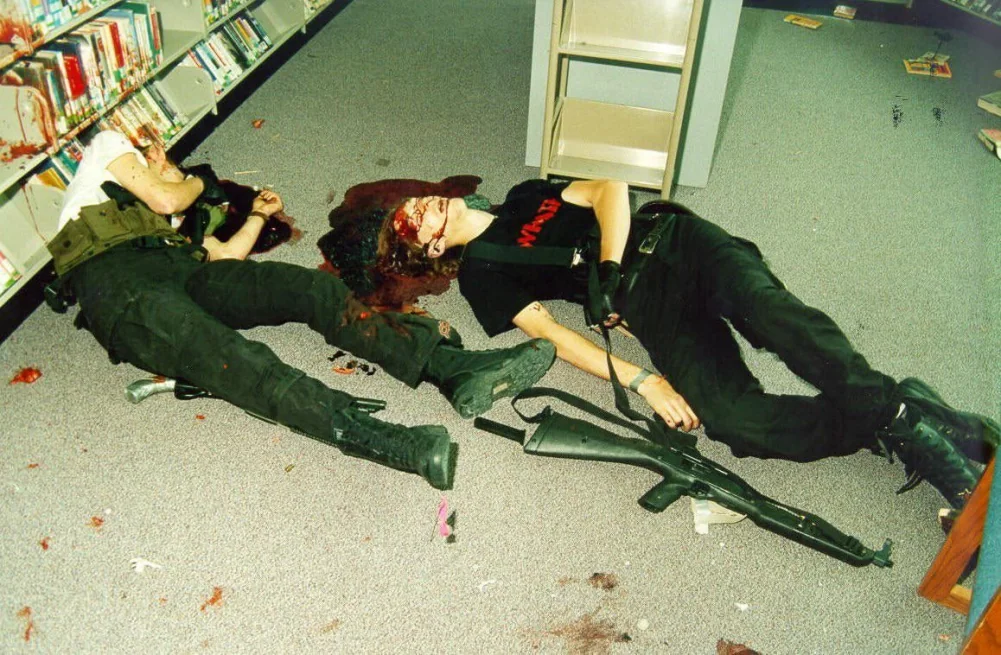
Harris and Klebold enter the school library, where approximately 50 people are hiding. Patti Nielson, a teacher, is among those who contact emergency services and attempt to protect students. The attackers shoot students hiding under tables and around furniture. They taunt and threaten victims and make statements suggesting that they are excited about carrying out the attack. Ten students are killed in the library, and others are wounded. Approximately 11:36 a.m.–12:00 p.m. — Movement through the school Harris and Klebold leave the library and continue moving through the building. They return to the cafeteria, where their planned propane bombs have failed to detonate. The perpetrators fire weapons and interact with the remaining explosive devices. The school fire alarm and sprinkler system activate. They eventually return toward the library. 12:06–12:08 p.m. — The deaths of Harris and Klebold SWAT officers begin entering the school. Harris and Klebold return to the library. At approximately 12:08 p.m., both perpetrators die by suicide from gunshot wounds to the head. Afternoon — Police search and rescue Police continue searching the building and securing the school. Officers encounter injured students, deceased victims, and unexploded devices. Rescue operations continue for several hours. Dave Sanders, who had been critically wounded while helping students, dies from his injuries. The bodies of Harris and Klebold are formally located and processed during the subsequent police search. The most important timeline correction is that the perpetrators died at approximately 12:08 p.m., not between 12:06 and 1:30 p.m. SWAT entry began shortly before their deaths, and the library was not fully searched and secured until much later. The perpetrators' writings and statements One of the most significant sources for understanding the perpetrators' psychological states is their personal writing. Klebold's journal is particularly revealing because it documents his emotional state in the months leading up to the attack. One entry reads: "I swear -- like I'm an outcast, & everyone is conspiring against me..." This statement illustrates his perception of social isolation and persecution. He appeared to believe that other people were against him, reinforcing his feelings of alienation. Another particularly disturbing entry was written approximately one day before the massacre: "About 26.5 hours from now the judgement will begin." He continued by describing his anticipation of death and referring to the experience as interesting and fun. This entry demonstrates that Klebold had incorporated death into his expectations for the following day. Rather than viewing the attack as an ordinary act of violence, he appeared to conceptualize it as a final event that would give meaning to his life. His references to judgment, death, and his own anticipated destruction suggest a combination of suicidal thinking, grandiose fantasy, and detachment from ordinary consequences. It is important, however, not to interpret these writings as proof of a particular personality disorder. They are evidence of his thoughts and emotional state, not a substitute for a clinical assessment. Their chosen identities Harris and Klebold also used nicknames. Dylan Klebold: Used the name VoDKa, a nickname associated with alcohol. Eric Harris: Used the name REB, short for Rebel. They also referred to certain activities as rebel missions. These activities involved vandalism, harassment, and other acts of intimidation. Their use of these identities reflects the development of a shared subculture in which aggression, rebellion, and hostility became increasingly normalized. Media coverage and misconceptions The Columbine massacre received enormous national and international media attention. The attack changed public discussions surrounding school safety, violence, emergency response, and the influence of media coverage. One of the most persistent misconceptions involved the so-called Trench Coat Mafia. Early reporting frequently associated Harris and Klebold with this group because of their clothing and perceived social identities. However, the popular narrative that they were simply members of a unified group of bullied outcasts who carried out the attack together is misleading. Their clothing and social associations became heavily sensationalized, and early reporting often relied on incomplete information. Another misconception was that the attack was exclusively motivated by bullying. Although the perpetrators expressed resentment toward classmates and popular students, their plans and writings reveal a much broader combination of motives, including revenge fantasies, ideological hatred, grandiosity, suicidal thinking, and a desire for notoriety. The media's early portrayal of the massacre also contributed to the development of myths about the perpetrators, their social circles, and their motivations. It is important to distinguish between the perpetrators' own explanations, eyewitness accounts, investigative findings, and later media interpretations. The Jefferson County investigation provides a substantially more reliable foundation for understanding what happened than the early news coverage. Conclusion The Columbine massacre was the result of an extended period of planning, escalating violent ideation, and the development of a shared destructive worldview between Eric Harris and Dylan Klebold. Neither individual should be viewed simply as the mastermind and the follower. Both participated willingly in the preparation and execution of the attack. Although their psychological presentations differed, they reinforced one another's hostility, resentment, and increasingly violent fantasies. Harris's writings frequently reflected grandiosity, contempt, aggression, and a desire for power. Klebold's writings more frequently reflected depression, alienation, suicidal thinking, and feelings of rejection. However, these differences did not prevent either individual from participating in the massacre. Their perceived victimization and resentment toward classmates may have contributed to their motivations, but bullying alone cannot explain the scale or nature of their actions. Their writings also reveal ideological hatred, fantasies of superiority, revenge, and an interest in achieving notoriety. Ultimately, the attack was not a justified response to social rejection or mistreatment. It was a deliberate mass murder of innocent people, including students and a teacher who had no responsibility for the perpetrators' personal grievances.